
Small Town Walkable Life: Finding Pedestrian-Friendly Communities in Ontario
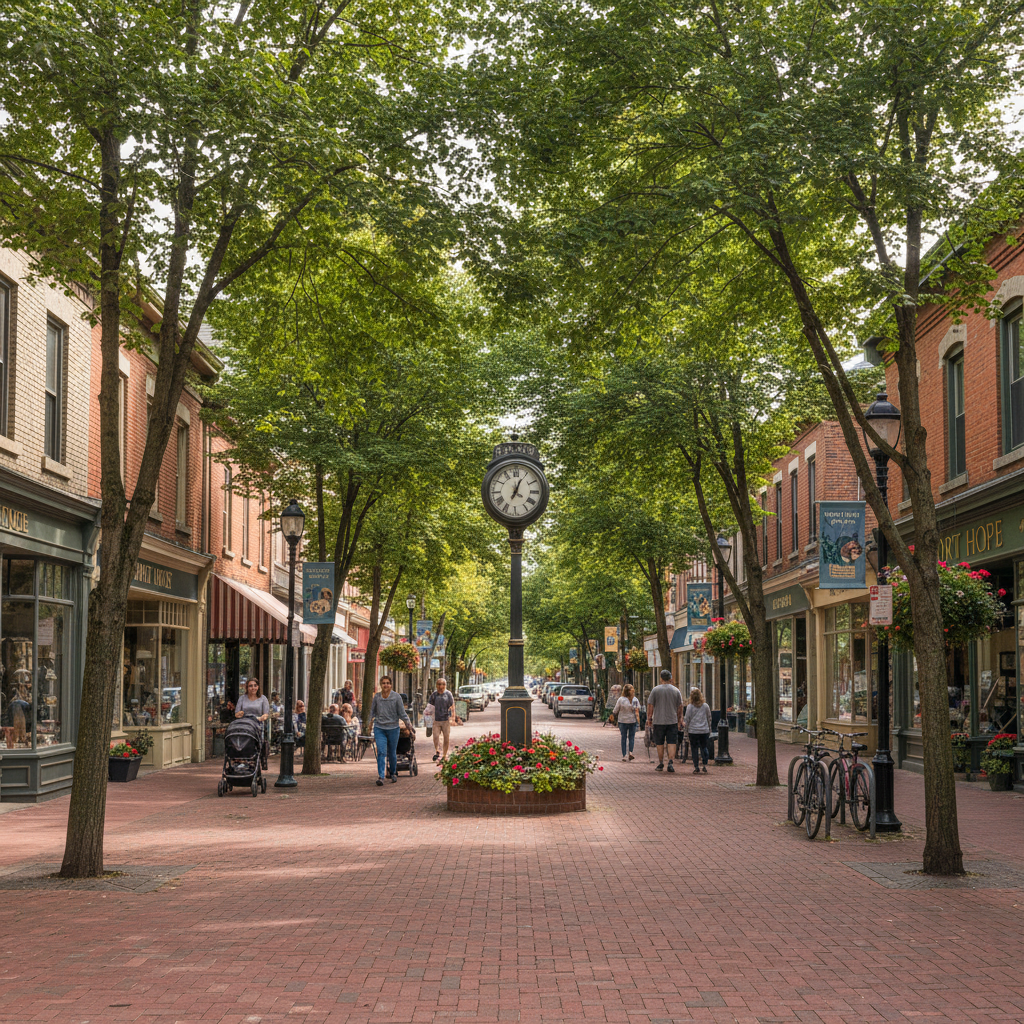
Ontario has hundreds of small towns, but not all of them are easy to navigate on foot. Some were built around historic main streets where shops, services, and public spaces sit within a comfortable walking distance of residential areas. Others grew outward along highway corridors, requiring a car for every errand. The difference between these two patterns has a real effect on daily health, social connection, and quality of life.
If you are considering a move to a smaller community, or you already live in one and want to understand what makes some towns feel more livable than others, walkability is one of the most important factors to examine.
What Walkability Actually Means in Small Towns
Walkability is often discussed in the context of big cities, where transit access, density, and mixed-use buildings are the key ingredients. In small towns, the formula is different. You are not looking for subway stations or ten-storey mixed-use buildings. Instead, walkability in a small Ontario town comes down to a few practical questions.
Can you walk to a grocery store, pharmacy, or post office without crossing a four-lane highway? Are there sidewalks on both sides of the main roads, and do they connect to residential streets? Is there a park, trail, or waterfront within a fifteen-minute walk of most homes? Are the streets safe and comfortable enough that children can walk to school and seniors can reach the library without feeling endangered?
Towns that answer yes to most of these questions tend to have something in common: a compact, connected core. They were often established before the automobile dominated land-use planning, and their original layout survived later waves of sprawl development.
The Health Benefits of Walking Daily
Walking is the most accessible form of physical activity. It requires no equipment, no gym membership, and no special skills. The health benefits are well documented: lower blood pressure, improved cardiovascular fitness, better weight management, reduced risk of type 2 diabetes, and significant mental health improvements including reduced anxiety and depression.

What makes walkable communities special is that they build physical activity into the fabric of daily life. You do not have to set aside time for exercise when your morning coffee run, trip to the hardware store, and visit to the park all happen on foot. Research from the Canadian Institute for Health Information has shown that residents of walkable neighbourhoods accumulate significantly more physical activity than those in car-dependent areas, even when they do not consider themselves "active."
For families, walkable towns offer children the chance to develop independence and spatial awareness. A child who walks to school, rides a bike to a friend's house, and explores the neighbourhood on foot grows up with a fundamentally different relationship to their community than one who is driven everywhere.
What to Look for When Evaluating a Small Town
If you are visiting a town with the idea of moving there, spend time walking it rather than driving through. Here are specific things to observe.
Sidewalk continuity. A town might have excellent sidewalks on the main street but none on the residential roads that feed into it. Walk from the edge of the residential area to the commercial core and note where sidewalks begin, end, or disappear. Missing sidewalks force pedestrians onto road shoulders, which is uncomfortable and dangerous, especially in winter conditions.
Street trees and shade. Mature street trees make a dramatic difference in walking comfort, particularly from May through September when sun exposure and heat can discourage outdoor activity. Towns with established canopy along their main routes are more pleasant to walk in and tend to have quieter, cooler streets overall.
Speed and traffic volume. The speed of passing vehicles affects the perception of safety more than almost any other factor. A street with cars moving at 40 km/h feels very different from one where traffic flows at 60 or 70. Some Ontario towns have reduced speed limits in their cores and installed traffic calming features like bump-outs, raised crosswalks, and narrowed lanes. These details signal a municipality that takes pedestrian comfort seriously.
Destinations within walking distance. Count the number of useful destinations you can reach within a fifteen-minute walk from the centre of the residential area. Grocery, pharmacy, restaurant, library, park, school, and medical clinic are the basics. A town does not need to have everything, but the more daily needs you can meet on foot, the less car-dependent your life will be.
Ontario Towns That Get It Right
Several Ontario small towns are frequently cited as examples of pedestrian-friendly design. Places like Elora, Picton, Bayfield, and Almonte share common traits: a well-preserved historic core, a grid or semi-grid street pattern, mixed-use buildings where shops occupy the ground floor, and public gathering spaces that draw people outdoors.
These towns did not necessarily plan for walkability in a deliberate, modern sense. They simply retained the layout that preceded car-centric planning. The lesson is that preserving older street patterns and resisting the urge to widen roads or push commercial activity to highway-side plazas pays long-term dividends for livability.

Newer towns and subdivisions can also achieve walkability, but it requires intentional design. Connected street grids rather than cul-de-sac patterns, mixed-use zoning in the core, and dedicated pedestrian paths linking neighbourhoods to commercial areas are the key ingredients. If you are looking at a newer development in a small town, check whether these elements are present in the site plan.
The Social Dimension
Walkability does more than support physical health. It creates opportunities for the kind of casual social interaction that strengthens community bonds. When you walk to the post office, you run into neighbours. When children walk to school together, friendships form. When seniors can stroll to a coffee shop without needing a ride, isolation decreases.
In small Ontario towns, where populations are modest and social networks matter enormously, the ability to bump into people while going about daily life is one of the most underrated contributors to community health. It is also something that traditional online walkability scores completely fail to capture.
Speaking of which, it is worth understanding what walkability scores actually measure and what they miss, especially in smaller communities where the algorithms tend to undercount local assets.
Practical Steps for Residents
If you already live in a small Ontario town and want to improve walkability, there are effective approaches at the municipal level. Attending public planning meetings and advocating for sidewalk connections, lower speed limits in residential areas, and pedestrian-priority zones in the commercial core can shift priorities over time.
At the household level, choosing to walk for short trips instead of driving models behaviour for neighbours and children. Supporting local businesses on foot rather than driving to big-box stores on the outskirts reinforces the economic viability of the walkable core.
Small towns in Ontario are at a crossroads. Growth pressure is pushing many of them to expand outward in car-dependent patterns. But the towns that protect and enhance their walkable cores will be the ones that attract residents looking for a healthier, more connected way of life.