Green Corridors and Connected Neighbourhoods
Healthy Landscapes Ontario | December 5, 2025
Green corridors serve as both ecological connections and neighbourhood links, providing habitat continuity alongside walking and cycling routes.
Most Ontario communities have parks. What they lack is connections between those parks. A typical suburban municipality might have dozens of neighbourhood parks, several larger community parks, a trail system, and nearby conservation areas, all functioning as isolated islands of green in a sea of roads, parking lots, and buildings. Each park serves its immediate surroundings, but moving between them on foot or by bicycle often means navigating hostile streetscapes designed primarily for cars.
Green corridors change that equation. By linking parks, natural areas, and open spaces through continuous green connections, they create networks that serve both people and wildlife. A corridor might follow a creek valley, a hydro easement, an abandoned rail line, or simply a wide boulevard with tree cover and a separated path. What matters is continuity: a route that feels safe, comfortable, and green from one end to the other.
The Fragmentation Problem
Ecological fragmentation is well understood in conservation biology. When habitat patches are isolated from each other, wildlife populations become small, genetically limited, and vulnerable to local extinction. The same principle applies, in a softer way, to human use of green space. When parks are disconnected, people use them less, travel farther to reach them, and miss the cumulative health benefits of moving through green environments as part of daily life.
In much of suburban Ontario, the gaps between parks are filled with the least pleasant parts of the built environment: wide arterial roads, strip mall parking lots, highway interchanges, and industrial blocks. Crossing these gaps on foot is unpleasant at best and dangerous at worst. The result is that each park serves only the residents within a 5-to-10-minute walk, rather than functioning as part of a larger system.
Green corridors address fragmentation for both people and ecosystems simultaneously. A naturalized corridor along a creek valley provides habitat for birds, pollinators, and small mammals while also serving as a shaded walking route for residents. The dual function makes the investment case stronger than either ecological restoration or trail construction alone.
Guelph's Trail and Greenway Network
The City of Guelph has one of Ontario's most developed greenway systems, built over several decades by systematically connecting natural areas, parks, and neighbourhoods through linear green corridors. The backbone of the system is the Speed and Eramosa river valleys, which run through the city and provide natural corridors that have been enhanced with trails, native plantings, and habitat features.
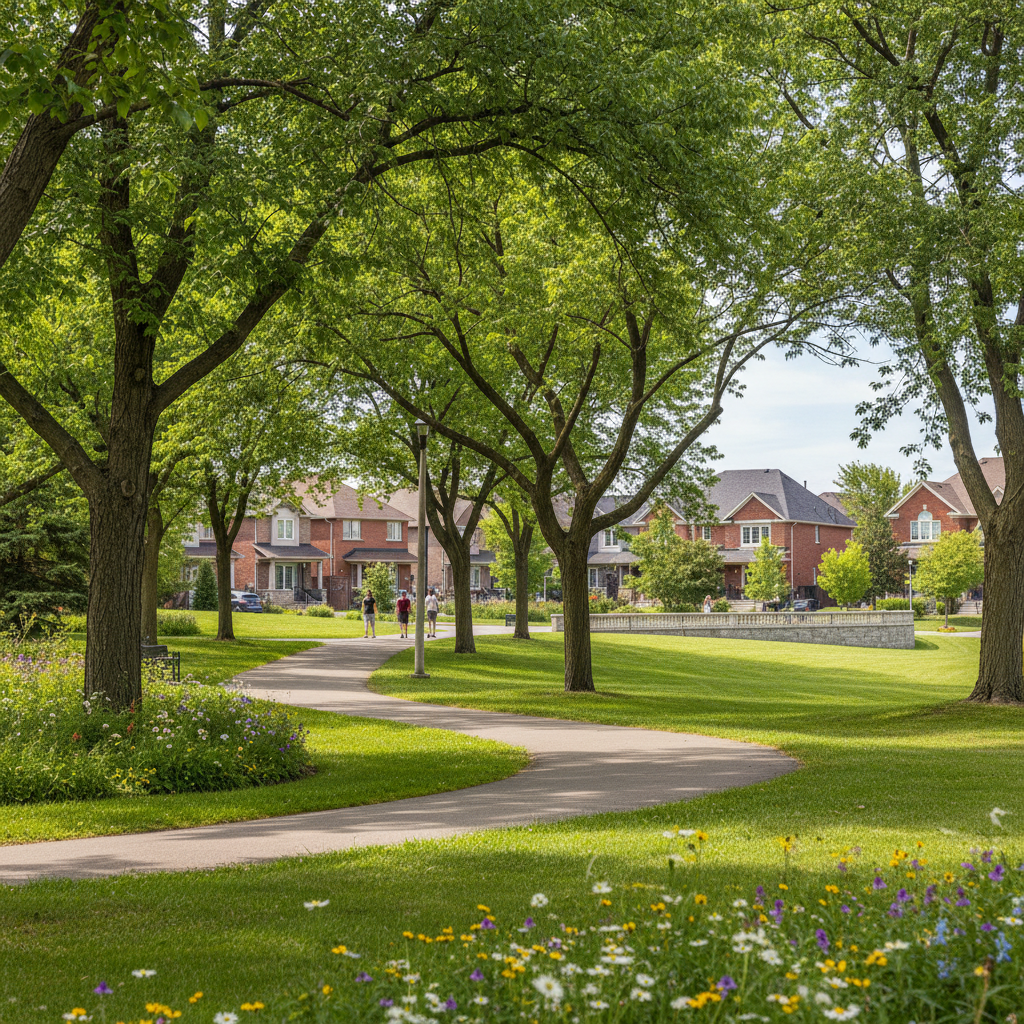
Greenway corridors through naturalized landscapes provide a qualitatively different walking experience than sidewalks along roads.
What makes Guelph's system effective is not just the river valleys, which are natural advantages, but the secondary corridors that connect the valleys to surrounding neighbourhoods. These include hydro easement trails, converted laneways, and designed green links through newer subdivisions. A resident in the south end of the city can walk or cycle to the university campus in the north end almost entirely on off-road green corridors, passing through parkland and alongside watercourses for the entire trip.
The system did not appear overnight. It is the product of decades of planning policy that required new developments to include trail connections and green links, combined with strategic land acquisitions and infrastructure investments to fill gaps in existing neighbourhoods. The early investments, which seemed modest at the time, compounded over decades into a network with transformative value.
The Mississauga Model
Mississauga, one of Ontario's largest suburban cities, faces a different challenge. Built primarily during the car-oriented development boom of the 1970s through 1990s, the city has extensive parkland but limited connectivity between green spaces. The road network is dominated by wide arterials and cul-de-sac subdivisions that make non-car travel circuitous and uncomfortable.
The city's response has been to identify and develop a network of "green connections" using existing but underutilized corridors. Credit River and its tributaries provide the primary north-south connections. East-west links use hydro easements, stormwater management corridors, and negotiated easements through commercial properties. The City's cycling and trails master plan maps the target network and prioritizes gap closures based on connectivity value and population served.
One of the most effective recent additions is the Etobicoke Creek trail, which connects a string of parks and natural areas along the creek from the north end of the city to the Lake Ontario waterfront. The trail passes through several distinct neighbourhoods, providing a continuous green route that residents of each area use for both recreation and transportation. Usage counts show steady growth since the last major gap was closed, with some sections recording over a thousand daily users during summer months.
Wildlife in the Corridor
Green corridors are not just for people. Ecological connectivity is a growing priority in Ontario conservation planning, as habitat loss and fragmentation continue to reduce wildlife populations across southern Ontario. Corridors allow animals to move between habitat patches, maintain genetic diversity, access seasonal resources, and recolonize areas after local disturbances.
In urban and suburban contexts, green corridors support a surprising diversity of wildlife. Studies conducted along the Don River valley in Toronto have documented over 200 bird species, dozens of mammal species, and a range of reptiles and amphibians using the valley corridor for movement and habitat. Similar studies in Guelph and Hamilton have found that connected green corridors support measurably higher biodiversity than isolated parks of equivalent size.
The design of corridors matters for wildlife. Narrow corridors with heavy edge effects (noise, light, domestic animals) provide limited habitat value, though they may still function for movement. Wider corridors with naturalized vegetation, minimal lighting, and buffer areas between the trail and the habitat core provide significantly better ecological function. The best corridor designs balance human access on well-defined paths with undisturbed habitat areas that wildlife can use without regular human disturbance.
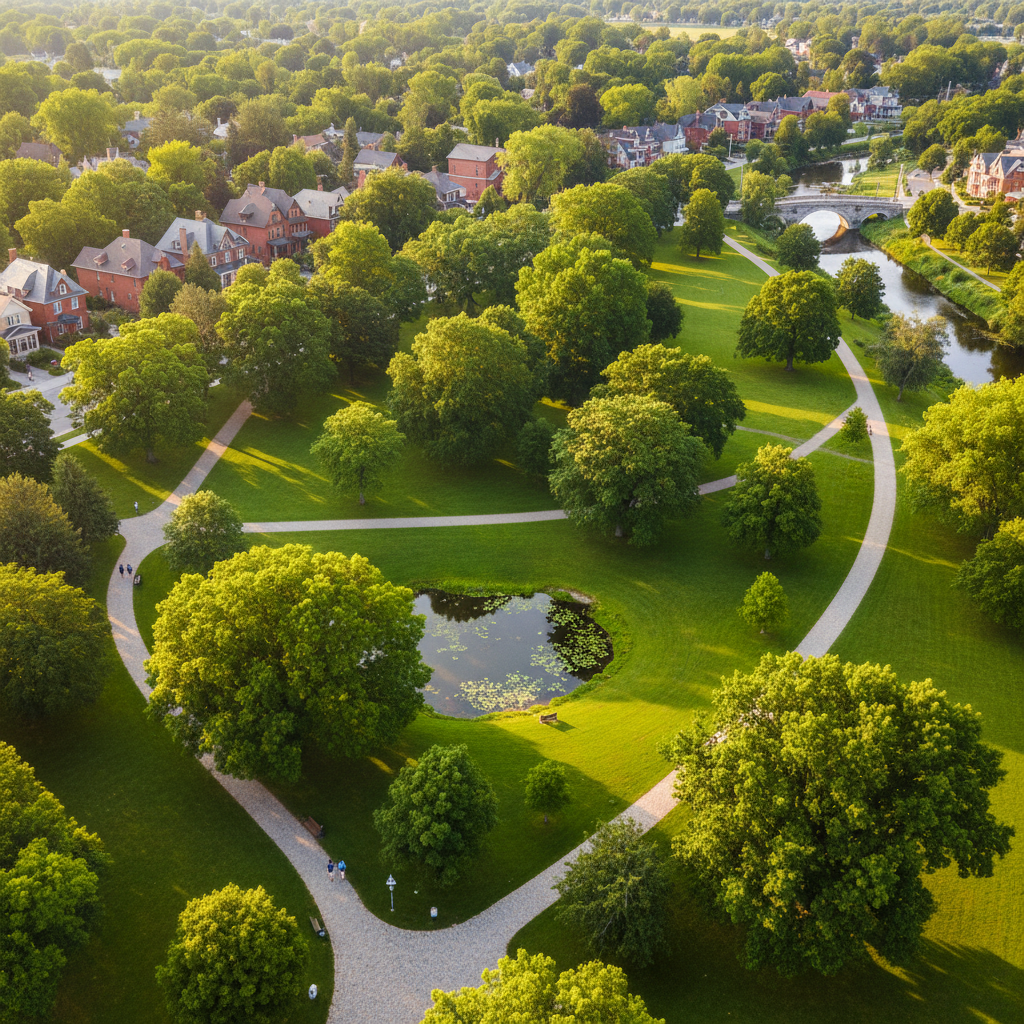
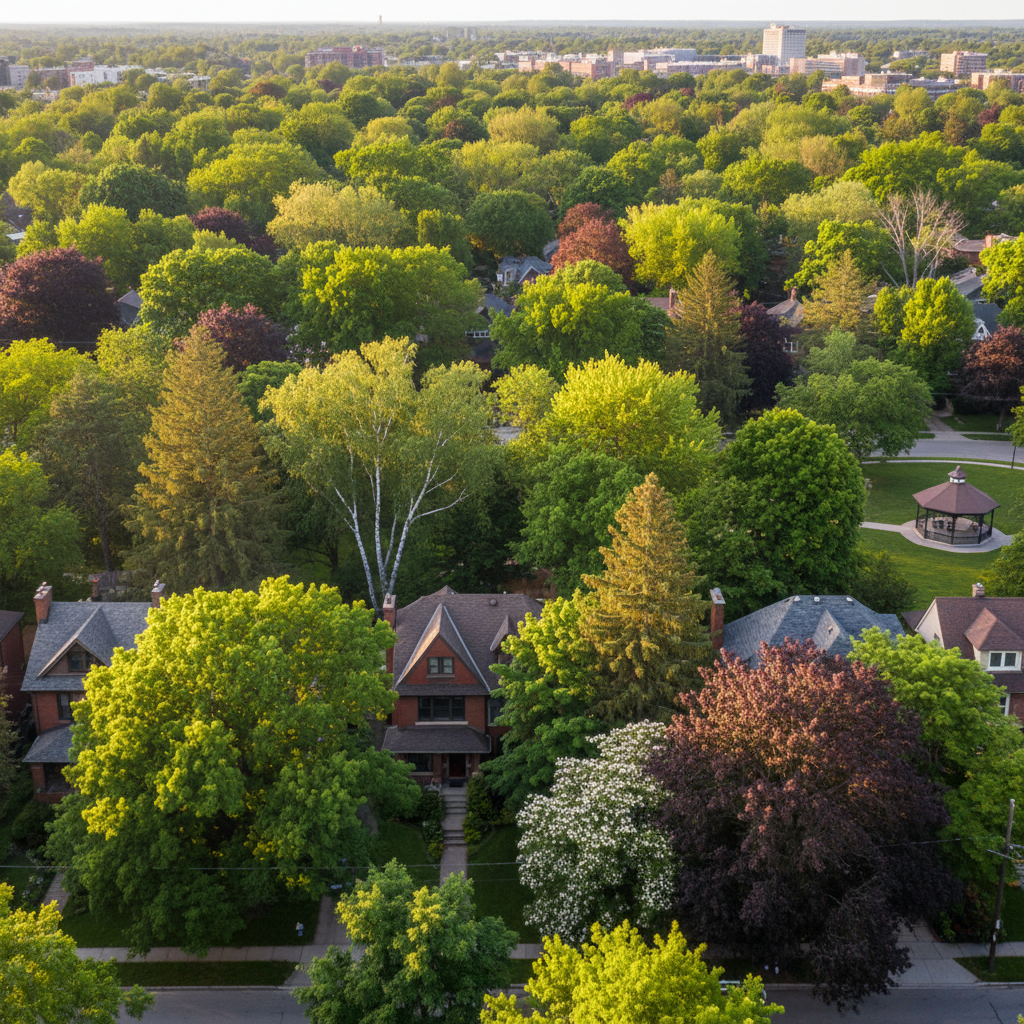
From the air, green corridors reveal the connected network of natural spaces that residents experience at ground level as continuous, walkable greenways.
Planning and Policy Tools
Creating green corridors requires several policy tools working together. Official plan policies can designate corridor lands and protect them from development. Parkland dedication requirements can be structured to prioritize linear connections over isolated park blocks. Environmental protection overlays on creek valleys and wetlands provide a starting framework of protected lands that can be enhanced with trail infrastructure.
Development approvals are a critical mechanism. When new subdivisions are built adjacent to existing corridors, the site plan can require trail connections, habitat buffers, and green links that extend the corridor into the new neighbourhood. This incremental approach, where each new development adds a piece to the network, is how Guelph built its system over time without requiring massive capital expenditures.
Land acquisition is sometimes necessary, particularly in built-up areas where no public corridor exists. Some Ontario municipalities have established dedicated land acquisition funds for strategic green connections, recognizing that the cost of purchasing a narrow strip of land to complete a corridor is modest compared to the network value it creates.
Lessons from Connected Communities
The Ontario communities with the strongest green corridor networks share a long-term planning orientation that treats connectivity as a fundamental objective rather than a nice-to-have. They have embedded corridor protection and development into their official plans, ensuring that each new development adds to rather than fragments the network. They maintain their corridors to standards that make them usable year-round, recognizing that a corridor blocked by fallen trees or flooded by poor drainage is a corridor that people stop using.
Most importantly, they understand that the value of a green network is exponential rather than linear. Ten disconnected parks serve ten neighbourhoods. Ten parks connected by green corridors serve an entire city. The canopy, habitat, and health benefits multiply when green spaces function as a system rather than as scattered fragments. Ontario has the raw materials for extraordinary green networks. The work is in connecting them.