Naturalized Schoolyards in Ontario
Healthy Landscapes Ontario | January 20, 2026
Naturalized schoolyards replace asphalt with living landscapes that serve as both play spaces and outdoor classrooms.
The typical Ontario schoolyard is a study in hard surfaces. Asphalt stretches from the building to the fence line, interrupted by a few pieces of playground equipment and perhaps a narrow strip of grass along one edge. It is hot in summer, icy in winter, and barren in every season. For the children who spend recess and lunch there five days a week, it offers limited options: run around on the pavement, use the climbing structure, or stand along the wall.
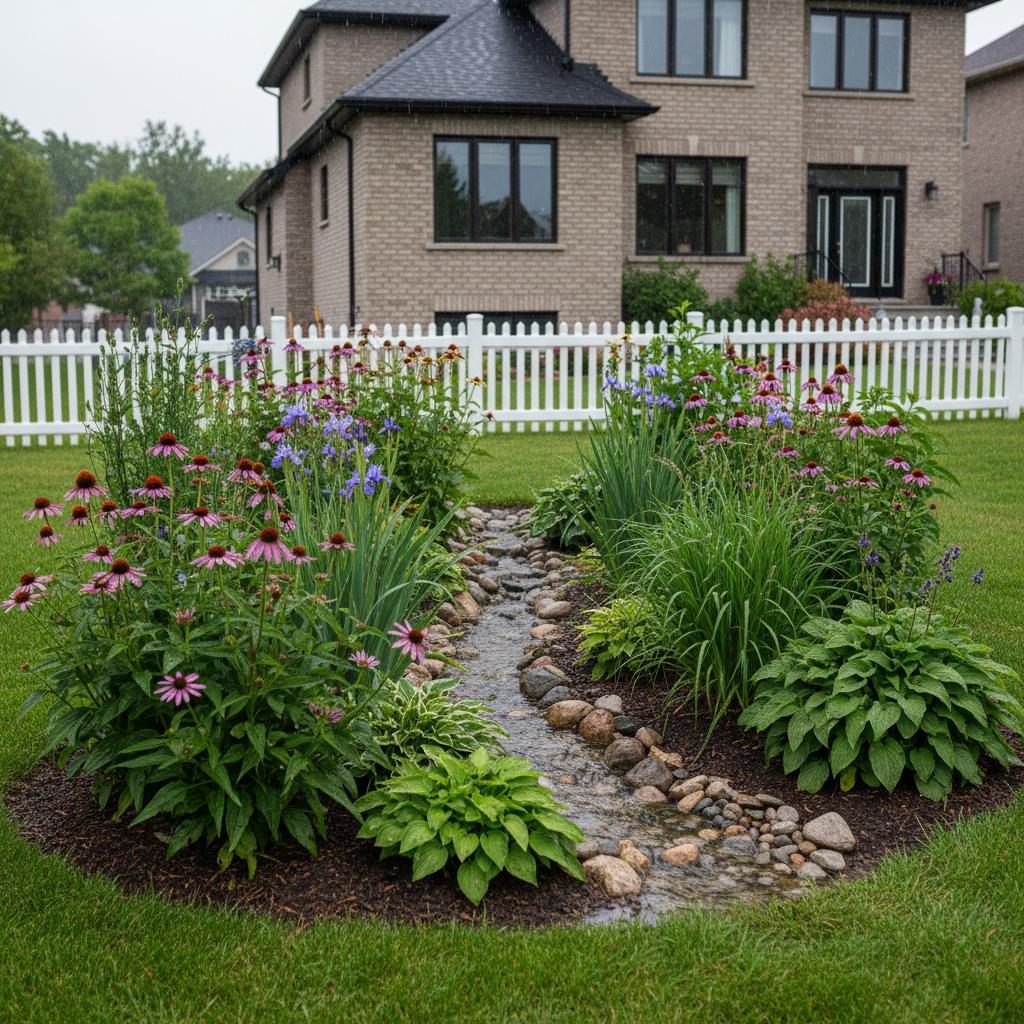
Now picture a different schoolyard. Part of the asphalt has been removed and replaced with a garden of native plants. There is a cluster of trees providing shade over a small outdoor classroom area with log seating. A shallow bioswale captures rainwater from the remaining pavement and channels it through a rock-lined bed planted with rushes and wildflowers. Boulders and stumps provide climbing and balancing surfaces. A small vegetable garden sits near the school entrance, maintained by students and used in science and nutrition lessons.
This second schoolyard exists at dozens of Ontario schools today. The naturalized schoolyard movement has been growing steadily across the province, driven by teachers who want outdoor learning spaces, parents concerned about screen time and sedentary habits, and school boards recognizing that grounds can be educational assets rather than just maintenance obligations.
Why Schoolyards Matter
Ontario has approximately 4,000 publicly funded elementary schools, and their combined grounds represent a significant portion of the province's urban and suburban green space. In many neighbourhoods, the school property is the single largest piece of open land. Yet most of it is paved, mowed, or otherwise managed in ways that provide minimal ecological, educational, or recreational value.
Children spend a substantial portion of their day on school grounds. Between before-school arrival, morning recess, lunch recess, and after-school activities, a typical elementary student may spend two to three hours per day in the schoolyard. For children in apartment buildings or homes without yards, the schoolyard may be their primary outdoor space. How that space is designed directly affects their physical activity, mental health, and relationship with the natural world.
Research from the Evergreen Foundation, which has supported schoolyard naturalization across Canada for over 20 years, documents consistent benefits. Schools with naturalized grounds report reduced bullying, increased physical activity, improved attention and focus in afternoon classes, and greater use of outdoor spaces for curriculum-based learning. The effects are not subtle. Teachers at naturalized schools consistently describe the transformation as one of the most impactful changes they have experienced in their careers.
The Waterloo Region Experience
The Waterloo Region District School Board has been a leader in schoolyard naturalization in Ontario. Starting with a handful of pilot schools in the early 2010s, the board has now naturalized portions of schoolyards at over 30 elementary schools across Kitchener, Waterloo, and Cambridge.
The approach varies by site but follows a general pattern. An assessment identifies areas of the schoolyard that are underused, poorly drained, or excessively hot. Community engagement, including student input, identifies priorities for new features. A landscape plan is developed, typically in partnership with a local conservation authority or the Evergreen Foundation. Implementation happens in phases, often over two to three years, with each phase funded through a combination of board capital funds, parent fundraising, municipal grants, and conservation authority programs.
Meadow plantings on former mowed turf provide habitat for pollinators while creating outdoor learning opportunities for students.
Common features include shade trees planted in clusters rather than rows, rain gardens that handle runoff from the remaining pavement, native plant gardens with interpretive signage, outdoor classroom areas with seating, and nature-based play features like boulders, logs, and sand. Some schools have added vegetable gardens, berry patches, or small fruit tree plantings that students maintain as part of their school day.
At Lincoln Heights Public School in Waterloo, the naturalization project removed approximately 30 percent of the asphalt surface and replaced it with a mix of native plantings, a rain garden, and a natural play area. The school tracked student behaviour before and after the project and found a measurable decrease in recess conflicts and a significant increase in the number of students who chose to spend time in the naturalized areas rather than on the remaining asphalt.
Outdoor Learning in the Curriculum
Naturalized schoolyards are most effective when they are integrated into the regular curriculum rather than treated as separate from classroom learning. Ontario's curriculum framework includes numerous expectations in science, geography, art, and physical education that can be taught more effectively outdoors than in a classroom.
A rain garden becomes a lesson in the water cycle, soil science, and ecological systems. A pollinator garden supports units on life cycles, adaptation, and interdependence. A vegetable garden connects to nutrition, food systems, and measurement. Even math can move outdoors when students measure tree growth, calculate garden areas, or collect and analyze data from weather stations.
The schools that get the most educational value from their naturalized grounds are the ones where teachers have been supported with professional development in outdoor education techniques. The physical space matters, but teacher confidence and skill in using it matters more. School boards that invest in teacher training alongside physical naturalization see stronger and more sustained educational outcomes.
Several Ontario Faculties of Education, including those at Lakehead University and the University of Ottawa, have incorporated outdoor and place-based education into their teacher preparation programs. Graduates of these programs arrive in schools with the skills to use naturalized grounds effectively, creating demand for the physical spaces where those skills can be applied.
Community Benefits Beyond School Hours
Ontario schoolyards are public spaces in a practical sense, even though they are technically school board property. After school hours, on weekends, and during the summer, schoolyards serve as neighbourhood parks for surrounding residents. A naturalized schoolyard that provides shade, seating, and interesting spaces attracts far more community use than a flat asphalt pad.
Schoolyard naturalization projects often involve parents, neighbours, and community volunteers alongside students and staff.
In neighbourhoods with limited park space, this community function is significant. A naturalized schoolyard can serve as a de facto community garden, gathering space, and nature area for the entire neighbourhood. Some Ontario schools have formalized this dual use through joint-use agreements with their municipality, which provide shared access to the grounds and sometimes shared maintenance responsibilities.
The community involvement in building and maintaining naturalized schoolyards also creates social connections. Planting days and maintenance events bring parents, neighbours, local businesses, and community organizations onto school grounds in a collaborative context. These events build relationships that extend beyond the schoolyard and strengthen the broader community fabric.
Barriers and How Schools Overcome Them
The most common barrier to schoolyard naturalization in Ontario is institutional. School boards are large, risk-averse organizations with maintenance budgets stretched thin. A proposal to remove pavement and plant gardens can face resistance from facilities staff concerned about maintenance costs, administrators worried about liability, and even some parents who associate "natural" with "messy" or "neglected."
Schools that have successfully navigated these barriers share several strategies. They start small, with a single garden bed or a few trees, and demonstrate success before proposing larger changes. They document the benefits through student surveys, behaviour data, and teacher feedback. They build broad coalitions of support that include parents, teachers, administrators, and community partners. And they plan for maintenance from the beginning, identifying who will do what and where the resources will come from.
The liability concerns, while understandable, are largely addressed by existing standards and precedent. Ontario schools with naturalized grounds have not experienced higher rates of injury than those with conventional asphalt yards. In fact, the evidence suggests that diverse, natural play environments may reduce injury by spreading children across a larger area and encouraging a wider range of physical activities than the repetitive, high-speed play that occurs on featureless pavement.
Lessons for Ontario Schools
Schoolyard naturalization in Ontario works best when it is treated as a long-term process rather than a one-time project. The most successful examples have been built over three to five years, with each phase building on the last and incorporating lessons learned. They involve students directly in the design, planting, and maintenance, which builds ownership and learning that a contractor-installed project cannot replicate.
They connect the outdoor space to the indoor curriculum, ensuring that the investment in the grounds translates into daily educational use rather than occasional field trips. And they plan for the reality that outdoor spaces need ongoing care, identifying sustainable maintenance models that do not depend entirely on a single enthusiastic teacher or parent volunteer.
Ontario's 4,000 elementary schools represent an enormous opportunity to expand green space, improve children's health and learning, and strengthen neighbourhood communities. The tools and models are well established. What is needed is the institutional will to look at a schoolyard full of asphalt and see what it could become.