Trails as Everyday Public Infrastructure
Healthy Landscapes Ontario | October 20, 2025
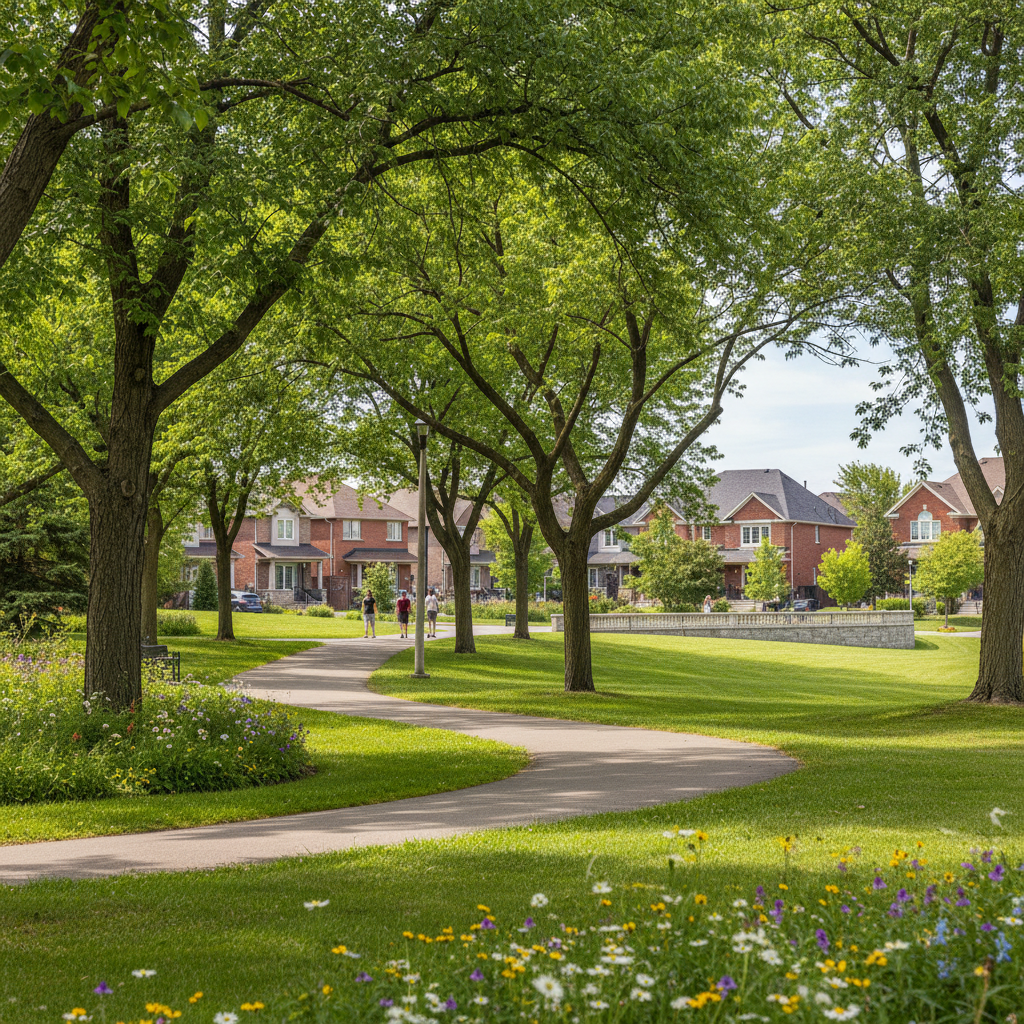
Multi-use trails serve as transportation routes, exercise corridors, and neighbourhood connectors all at once.
When people think about trails in Ontario, they tend to picture weekend hikes in conservation areas or autumn walks through forested parks. Trails feel like recreation. Something optional. Something you do when you have time.
But a growing number of Ontario communities are starting to treat trails differently. They are building and maintaining them as core public infrastructure, with the same seriousness they apply to roads, water mains, and transit routes. The shift is subtle but significant. It changes how trails get funded, where they get built, and who ends up using them.
The Rail Trail Model
Ontario has an extensive network of abandoned rail corridors, and many of them have been converted into multi-use trails over the past three decades. The concept is straightforward: old rail beds provide flat, graded routes that often connect town centres to surrounding communities. Converting them into trails is far cheaper than building new road connections, and the results are immediately useful.
The Iron Horse Trail in Waterloo Region is one of the clearest examples. Running through the heart of Kitchener and Waterloo, it serves as a commuting route for thousands of daily cyclists and pedestrians. It connects university campuses, commercial districts, residential neighbourhoods, and transit hubs. During peak hours, it functions less like a recreational path and more like a busy city street, except quieter, cleaner, and more pleasant to use.
What makes the Iron Horse Trail work as infrastructure rather than just recreation is maintenance. The Region clears snow and ice in winter. The surface is paved and graded for accessibility. Lighting is adequate for year-round use. These are the same standards applied to roads, and they make the trail viable for daily trips rather than just occasional outings.
Abandoned rail corridors provide ready-made trail routes connecting Ontario towns and neighbourhoods.
Trails That Go Somewhere
The trails that function as real infrastructure share a common trait: they connect useful destinations. A loop trail through a park is pleasant for exercise, but it does not change how people move through their community. A trail that links a residential neighbourhood to a school, a grocery store, or a transit stop changes daily routines.
In Guelph, the city's trail network was deliberately planned to connect major destinations. The system links the University of Guelph campus to the downtown core, several elementary schools, and multiple residential subdivisions. For families in the south end of the city, the trail provides a car-free route to schools and shopping that would otherwise require driving along busy arterial roads.
This destination-oriented approach to trail planning requires coordination with land use planning, something that has historically been rare in Ontario. Trails have traditionally been handled by parks departments, while transportation planning focuses on roads and transit. When these functions operate in silos, trails end up in leftover spaces rather than along useful corridors.
The municipalities that are getting the most value from their trail investments are the ones that have integrated trail planning into their transportation master plans. This means trails get evaluated using the same criteria as road projects: connectivity, capacity, safety, and cost-effectiveness.
Who Uses Trails When They Work as Infrastructure
When trails are well-connected and well-maintained, they attract a broader cross-section of users than typical recreational paths. Trail counters on the Iron Horse Trail in Waterloo show consistent weekday commute-hour peaks, indicating significant use for transportation rather than just exercise. The users include university students, office workers, parents with cargo bikes, and older adults who prefer the trail to busy sidewalks.
This diversity of users matters. A trail that serves only recreational walkers on weekends has a narrow constituency. A trail that also serves commuters, children going to school, and seniors doing errands has a broad base of support that makes it politically durable. When budget pressures arise, infrastructure that people depend on daily is harder to cut than amenities used occasionally.
There is also an equity dimension. In many Ontario communities, the neighbourhoods with the poorest walking and cycling conditions are also the ones with lower household incomes. A well-built trail through these areas provides safe, free mobility that does not depend on car ownership. In neighbourhoods designed primarily for cars, a trail can be the only comfortable route for a child to walk to school or an older adult to reach a park.
Volunteer trail maintenance groups contribute thousands of hours annually across Ontario trail networks.
The Maintenance Question
The biggest gap between trails-as-recreation and trails-as-infrastructure is maintenance. A trail that is only usable from May to October, that floods after every heavy rain, or that becomes impassable after a windstorm is not infrastructure. It is a seasonal amenity.
Year-round maintenance is what transforms a trail from a nice-to-have into something people can rely on. This includes snow clearing, surface repair, drainage management, vegetation control, and regular safety inspections. These tasks are routine for roads but often treated as optional for trails.
The cost of year-round trail maintenance is modest compared to road maintenance. A kilometre of paved trail costs a fraction of what a kilometre of road costs to maintain annually. But the funding structures in most Ontario municipalities do not reflect this. Trail maintenance often comes from parks budgets rather than transportation or infrastructure budgets, which means it competes with grass cutting and playground equipment rather than with road resurfacing and bridge repair.
Communities that have shifted trail maintenance into their public works or transportation departments report better outcomes. The maintenance gets done on a predictable schedule, the standards are clearer, and the budget is more stable. It is a bureaucratic change, not a dramatic one, but it makes a real difference in trail usability.
Building the Network
Individual trail segments, no matter how well built, have limited value. The real benefits emerge when segments connect into a network. This is the same principle that applies to roads: a single road between two points is useful, but a connected grid of roads enables an entire economy.
Ontario's trail networks are still fragmented in most communities. A common pattern is several disconnected trail segments, each well-maintained within its own boundaries, but separated by gaps that require users to navigate along busy roads or through parking lots. These gaps suppress usage far more than their physical length would suggest. A 200-metre gap on a fast road can make a trail feel unsafe for children and uncomfortable for most adults.
Closing these gaps is often the highest-value trail investment a municipality can make. The cost per metre of a gap closure is higher than the cost per metre of a trail in a greenfield development, because gaps tend to exist in built-up areas where land is constrained and engineering is complex. But the network effect of closing a gap, suddenly connecting two previously separate systems, produces outsized increases in usage across the entire network.
The City of Hamilton has been working through a systematic gap closure program as part of its cycling and trails master plan. Each closure project is relatively small in scope but contributes to a steadily expanding network that reaches more neighbourhoods each year.
Lessons from Ontario Trail Communities
The communities across Ontario that have successfully treated trails as infrastructure share several characteristics. They maintain trails year-round, to the same standards as other transportation assets. They plan trail routes to connect useful destinations rather than simply following the path of least resistance through leftover green space. They fund trails through infrastructure budgets rather than parks budgets, which provides more stable and adequate funding.
Perhaps most importantly, they think about trails as part of a network rather than as isolated amenities. A single trail is a nice feature. A connected trail network is a transportation system that reduces car dependence, improves public health outcomes, and makes communities more livable for people of all ages and abilities.
Ontario has the bones of an excellent trail network, with rail corridors, hydro easements, river valleys, and green belts providing ready-made routes. The question is whether municipalities will treat these routes as the essential infrastructure they can be, or continue to manage them as recreational extras that get plowed last and repaired when the budget allows.