
Moving to Ontario: An Environmental Checklist

Relocating to Ontario involves a long list of decisions, and most of them come down to practical concerns like commute times, school quality, and housing costs. But the environmental characteristics of your new community will affect your daily quality of life in ways that are easy to overlook during the moving process. Water quality, flood risk, air quality, noise levels, and access to green space all vary significantly across Ontario municipalities. Taking the time to evaluate these factors before you move can save you from expensive surprises and help you find a neighbourhood that genuinely supports your family's health.
This checklist covers the key environmental factors worth investigating when you are considering a move to an Ontario community. It is organized roughly in the order you might encounter these questions during a home search.
1. Water Quality and Source
The first question is whether the property is served by municipal water or a private well. Municipal water systems in Ontario are regulated under the Safe Drinking Water Act and subject to regular testing and public reporting. You can request the most recent annual water quality report from the local municipality, and many now publish these reports online. Look at the test results for common parameters like lead, trihalomethanes, and bacterial indicators. Most Ontario municipal systems consistently meet or exceed provincial standards, but older infrastructure in some communities can produce occasional exceedances worth knowing about.
If the property relies on a private well, the situation is different. Private wells are the homeowner's responsibility to maintain and test. Before purchasing a property with well water, have the well inspected and the water tested for bacteria, nitrates, and any contaminants common in the local area. Your local conservation authority can tell you about known groundwater quality issues in the region. For a deeper look at this topic, see our guide on rural well water safety.
2. Flood Risk
Flooding is one of the most expensive and disruptive environmental risks for Ontario homeowners. Before committing to a property, check whether it sits within a regulated floodplain. Conservation authorities maintain floodplain maps for their jurisdictions, and many municipalities include flood risk information in their official plans and zoning bylaws.
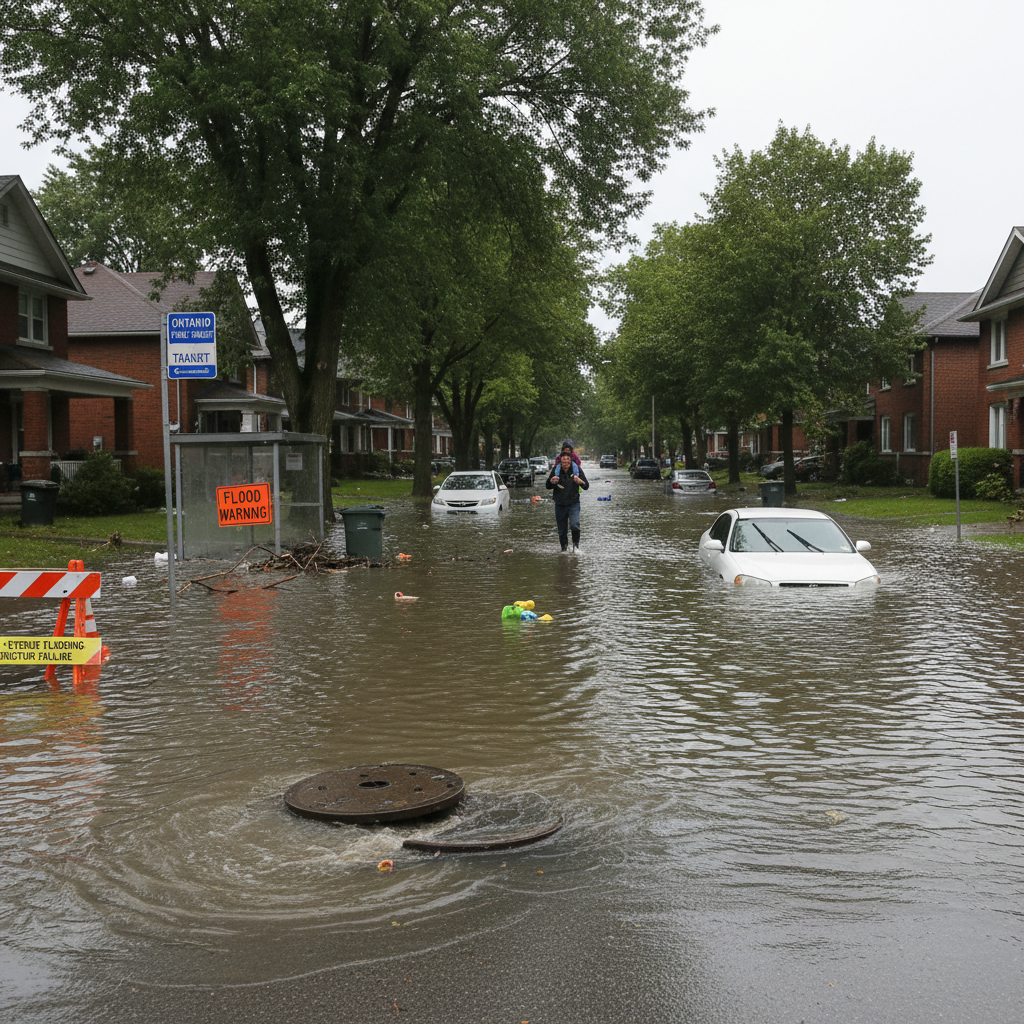
Even properties outside mapped floodplains can be vulnerable to basement flooding from overwhelmed storm sewers during heavy rainfall events. Ask the seller or their agent whether the home has ever experienced water in the basement. Check for a backwater valve, a sump pump, and proper grading away from the foundation. Our detailed guide on basement flooding prevention covers these steps in more depth.
3. Air Quality
Air quality in Ontario is generally good by global standards, but there are meaningful local variations. Properties near major highways, industrial facilities, or busy freight corridors tend to have higher levels of particulate matter and nitrogen dioxide. Research published by Health Canada suggests that living within 150 metres of a major highway is associated with increased rates of respiratory and cardiovascular conditions.
Check the Ontario Air Quality Index for monitoring station data near the communities you are considering. If a property is close to a highway or industrial area, our article on air quality near highways explains what to look for and how to assess the risk.
4. Green Space and Tree Canopy
Access to parks, trails, and natural areas has well-documented health benefits, from reduced stress levels to increased physical activity to better respiratory health in children. When evaluating a neighbourhood, look at more than just the nearest park. Consider the quality and connectivity of green spaces, the maturity of the tree canopy on residential streets, and whether there are accessible trails or natural areas within walking distance.
Municipalities with strong tree preservation bylaws and active urban forestry programs tend to maintain better canopy coverage over time. This matters for practical reasons beyond aesthetics. Mature trees reduce summer cooling costs, manage stormwater, and contribute to measurably cooler street temperatures. Our article on why trees matter covers these benefits in detail.
5. Walkability and Active Transportation
Can you walk to daily necessities? Are there sidewalks on both sides of the street? Is the route to the nearest school safe for children to walk or bike? These questions have both practical and health implications. Communities with good walkability tend to have residents who are more physically active, and they also tend to be quieter and safer for pedestrians.
Online walkability scores provide a rough starting point, but they miss important details. Sidewalk condition, winter maintenance, crossing safety at busy intersections, and the presence of shade along walking routes all matter and are not captured by algorithms. Walking the neighbourhood in person, at different times of day, gives you the most accurate picture.

6. Noise Environment
Traffic noise, rail noise, and industrial noise all affect sleep quality, stress levels, and long-term cardiovascular health. Ontario does not have a single provincial noise standard for residential areas, so the rules vary by municipality. Most municipalities regulate noise through bylaws that set limits on construction hours, amplified sound, and sometimes traffic-related noise from new developments.
When visiting a potential neighbourhood, pay attention to the ambient noise level. Visit at different times, including weekday mornings and evenings, to get a realistic sense of traffic patterns. Properties near rail lines may experience vibration as well as noise, which is harder to mitigate. If noise is a concern, see our article on noise pollution and residential health.
7. Stormwater and Drainage Infrastructure
How a municipality manages stormwater tells you a lot about the long-term resilience of the community. Newer subdivisions in Ontario are generally required to include stormwater management ponds, permeable surfaces, and other green infrastructure. Older neighbourhoods may rely on combined sewer systems that are more vulnerable to overflows during heavy rain.
Check the municipality's infrastructure master plan or asset management plan if they are publicly available. These documents outline the age and condition of underground infrastructure and planned capital investments. A municipality that is actively investing in stormwater upgrades is one that is planning for the realities of more intense rainfall events.
8. Environmental Regulations and Local Governance
Different Ontario municipalities have different approaches to environmental protection. Some have adopted strong tree preservation bylaws, pesticide restrictions, dark sky lighting standards, and development policies that protect natural heritage features. Others take a more minimal approach. The official plan for the municipality outlines the local policy framework for environmental protection and land use.
Conservation authorities play a major role in Ontario's environmental governance, particularly around watercourses, wetlands, and natural hazard areas. If a property falls within a conservation authority's regulated area, there may be restrictions on what you can build or modify. This is not necessarily a negative; it often means the area around you is better protected from the kind of development that can cause flooding or environmental degradation downstream.
9. Radon and Indoor Environmental Quality
Radon is a naturally occurring radioactive gas that seeps into buildings from the ground. It is the second leading cause of lung cancer in Canada, after smoking. Radon levels vary significantly across Ontario, and the only way to know whether a specific home has elevated levels is to test. Health Canada recommends testing for radon in every home, regardless of age or construction type. Test kits are inexpensive and widely available, and mitigation systems are effective if elevated levels are found.
10. Putting It All Together
No community will score perfectly on every environmental factor, and the relative importance of each item depends on your family's specific needs and priorities. A family with young children might prioritize air quality and walkable routes to school. A retiree might focus on noise levels and access to trails. What matters is that you are asking these questions before you commit to a location rather than discovering the answers after the fact.
Keep a simple checklist as you visit communities. Note what you observe firsthand and what you verify through municipal reports and provincial data sources. Real estate agents may not raise these topics, so it is up to you to investigate. The environmental character of your neighbourhood shapes your daily life in ways that persist long after the moving boxes are unpacked.